
Nodes operation in the GBLedger blockchain

The blockchain developed by Genesis Block is one of the fastest, well-scalable, functional and reliable systems based on the DPOS algorithm. The effectiveness of its work is guaranteed by special nodes which can be connected by any participant. In this article we will consider the principle of operation of such functionality.
Nodes are the computers with special software installed on them, connected to the network and ensuring the constant and uninterrupted operation of the blockchain. Nodes are necessary to confirm transactions and blocks, verify blocks and maintain the security and reliability of the entire blockchain.
Full nodes are nodes that have a copy of the entire blockchain. Full nodes are network arbitrators; they are the ones who check the correctness of transactions and blocks, as well as the correctness of finding the hash in the new block and, accordingly, the validity of the block and its eligibility to be added to the blockchain. Full nodes can also be called the main guards of the network, which ensure its security and operation. Full nodes that can write transactions to the blockchain are called consensus nodes (witness) or manners (miner). Full nodes that only verify the correctness of transactions are called audit nodes. Light clients do not store full copies of the blockchain, but interact with the network using full nodes.
Most of users use light clients or web wallets to make transactions. All notes are connected to each other. With such a set of elements the network architecture becomes more stable.

Transaction’s lifecycle
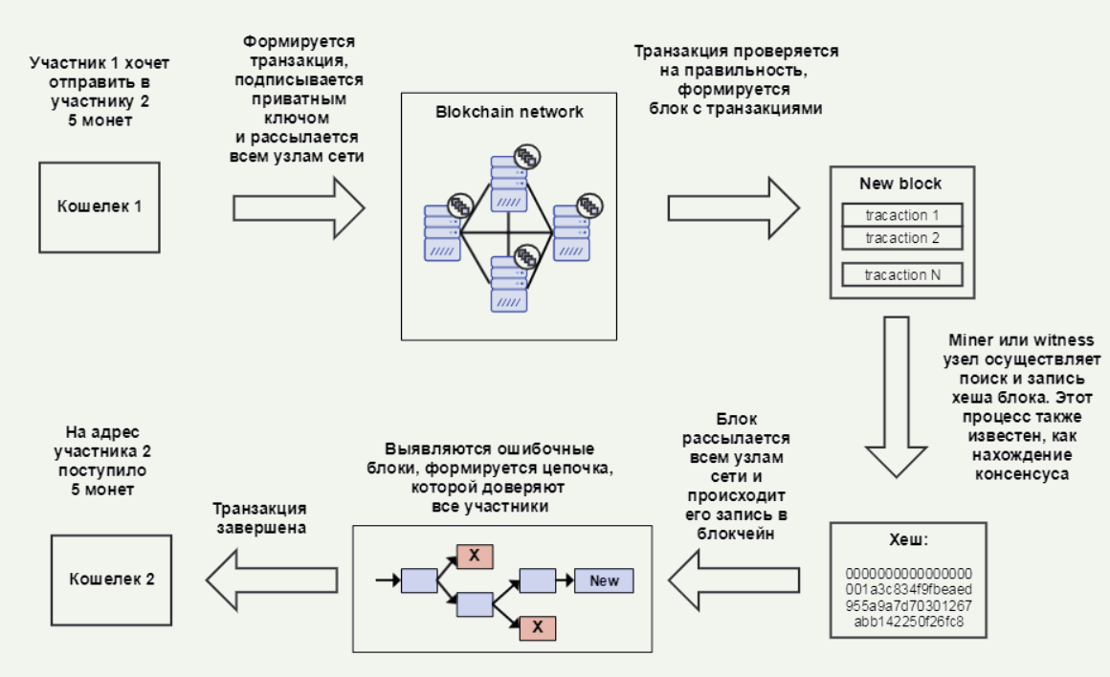
How the user is verified or authorized
Signature processes in verification take place in offline mode, i.e. on the client’s capacities (browser, wallet). Each user has three fields: login, private key, public key. We will consider only a small part of the functionality, which nevertheless gives an understanding of the general principles of operation.
- The wallet requests user data from one of the nodes (locally installed or external), providing a login.
- The node responds with the user’s parameters and his public key.
- Local wallet, we check whether the public key belongs to the owner’s private key.
- If this is the case, the local wallet allows further actions, but no information is sent to the network.
How does the network see this request for user parameters?
1. If this is a local node, the data is not blocked and the network cannot find out about this operation, since the full cast of the network is stored on your computer.
2. If this is a public node, the data is not logged.
How is the transaction generated and signed?
All the procedures for creating a transfer operation are performed on the client side without transmitting data to the network. The transaction (in its ”raw form») stores information about the following elements:
- recipient’s public key (not login);
- the amount of the commission;
- the coin required to pay the commission;
- the name of the coin;
- the number of coins.
Upon completion of all stages of preparation of the operation, the operation is signed with a private key. and an absolutely secure string is sent to the network. It is impossible to determine which of the public nodes the operation came from, because the network is connected by a peer-to-peer web and the network diverges instantly across all servers.
Читайте также:
>>> О КОМПАНИИ GENESIS BLOCK:
Компания Genesis Block – международный системный интегратор и разработчик финтех-решений, систем платежей и процессинга, систем биллинга и программных решений для ЖКХ, блокчейн-решений, веб-сайтов, порталов и мобильных приложений. Под брендом Genesis Block объединены компании, разработчики и сервисы, работающие на рынке с 2010 г. Качество наших сервисов подтверждается международной сертификацией по ISO. Входим в российскую ассоциацию программного обеспечения НП РУССОФТ. Genesis Block является постоянным главным спонсором и спикером на международных банковских и финансовых конференциях IFIN и ВБА (Вся Банковская Автоматизация). Аккредитованная IT-компания Минкомсвязи. Является членом РАКИБ (Российская Ассоциация Криптовалют и Блокчейна). С 2020 компания Genesis Block ведет собственную авторскую передачу на деловом телевидении ПРОБИЗНЕС. Являемся авторизованным официальным интегратором крупнейшей BPM / CRM системы Terrasoft.


