
8k — hi hd blockchain Gbledger (ENG)

Any discussion unfolded around the blockchain invariably divides its participants into two camps. In the first case, there are those who consider this technology to be a hype, inflated against the background of the growing cost of cryptocurrencies, and therefore they are sure that it is not even worth wasting time on it. The second is joined by those who have at least a little knowleges in the topic of distributed registries and are able to demonstrate the feasibility of blockchain using even if not by their own examples, but at least on the example of companies that have managed to find some application for it.
The first ones have been getting smaller lately. And this is due to the fact that exactly the same «hype» slowly but surely continues to transform the business environment, providing it with more and more opportunities that could only be dreamed of before. Blockchain is the new oil! It is already difficult for even the most desperate traditionalists to argue with such a statement in the middle of 2021. And is there any need to argue at all, when you can personally verify that the blockchain really changes the approach to the work of many industries, changing and simplifying our everyday’s life.
GBLedger blockchain platform, developed by Genesis Block specialists, is a vivid example of this because it can be used to solve a lot of tasks, the implementation of which previously spent a huge amount of time and money. What is GBLedger? Here are just a few options for its application:
- a platform for creating and managing digital assets;
- a platform for conducting digital crowdfunding campaigns;
- tokenization of loyalty programs and exchange of some loyalty points for others;
- money transfer systems;
- transparent and secure voting on the blockchain;
- building a system of distributed authorization centers, in which work with user data is carried out through the acceptance of the request by the user himself;
- alternative to FPS (fast payment system);
- a decentralized exchange for trading various assets
- invoice system;
- recurring payments;
- merchant platform.
GBLedger blockchain surpasses its competitors both in terms of reliability, as well as in terms of the speed of transactions and their cost within the network.
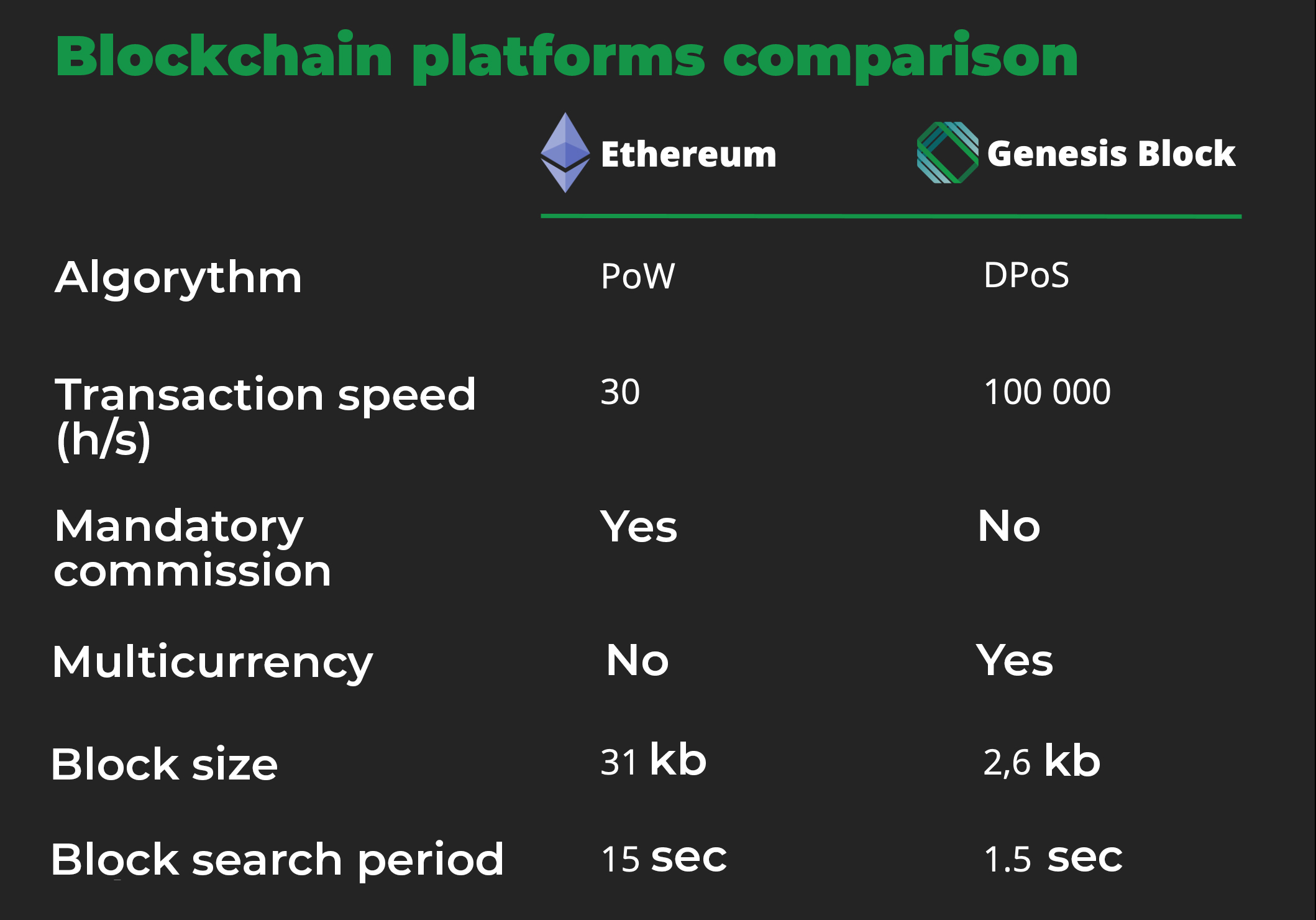
Thanks to its flexibility, scalability and versatility, GBLedger can become the basis for building a new type of fast and trouble-free financial systems. And since we have mentioned the speed of our blockchain several times, it is worth telling about this advantage of GBLedger separately.
Workload testing of the GBLedger blockchain
Workload testing in the blockchain has as its main goal to establish peak throughput in various operating conditions. After all, the speed of work and the number of simultaneously performed operations (transactions) depend on this factor.
The test environment is deployed on 3 servers with the following characteristics:
— 2 VCPU
— 2GB RAM
— 50 GB SSD
— 200 Mb network channel
Each server contains 3 network nodes:
- SEED node — a technical node that stores the entire warhead and synchronizes the network with each other;
- Witness node — fulfills the obligations of signing and verifying each block;
- Public node — responsible for the public JSON-RPC interface. It responds both via the HTTP and WebSocket protocols (for the possibility of quick data updates and direct communication with the client).
The scheme of operation of such a working environment looks like this:
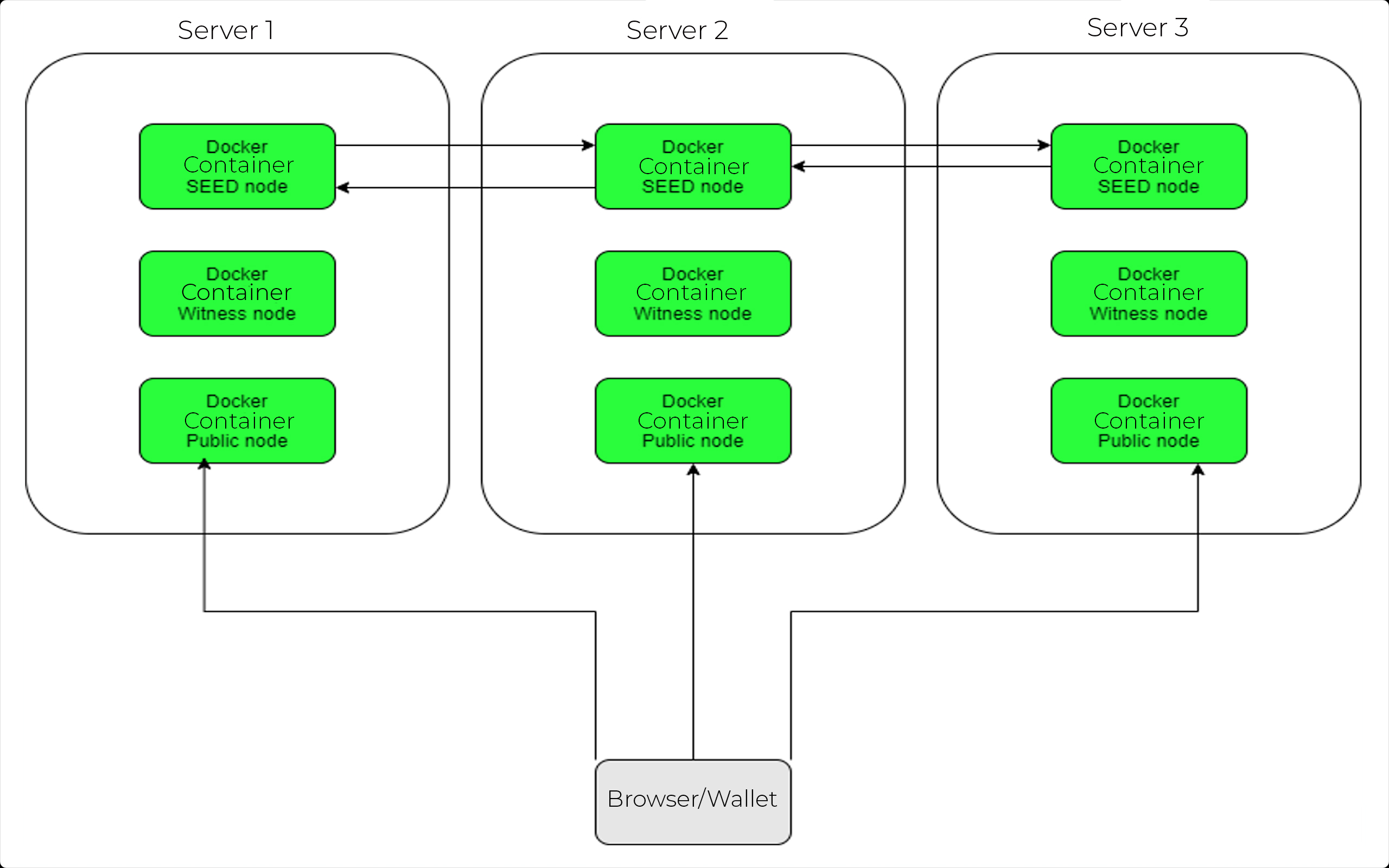
Each of the nodes is running in a Docker container. There are 3 nodes running on each server. Public nodes interact and receive data from SEED nodes, communication takes place through them. They also contain the entire cast of the blockchain. They are Full nodes. For the purity of the experiment, the load was directed to «Server 3»
Two servers with the following characteristics are used:
— 8 VCPU
— 3 RAM
— 20GB SSD
All public nodes communicate with the outside world through nginx proxying. It is also possible to implement it via HaProxy, which will make it possible to automatically provide the client to the node with the least load.
An application for generating transactions in the blockchain
This application is written in the nodejs programming language and is responsible for:
— Creation of trading operations on the exchange (GBL – USDT trading pair)
— Creation of money transfer operations from User A to user B with a dynamic amount.
Generating operations and sending them to the network.
Types of operations performed:
create_transfer — The operation of transferring funds from user A to B
create_limit_order — Creating a trading pair in the exchange
Interfaces: — Console
An application for performing procedures for reading data from the blockchain
This application is responsible for:
— Generation of requests for obtaining data from the blockchain;
— Generation of write operations in the warhead for generating the load by means of separate operations without grouping.
Programming language: python
Types of operations performed:
get_block
get_transaction
get_chain_properties
get_global_properties
get_config
get_chain_id
get_dynamic_global_properties
get_accounts
The configuration file has the following structure:
{
«scenarios»: [
{
«node»: «wss://node1.gbledger.net/ws»,
«cycles»: 100000,
«workers»: 80,
«time_limit»: 5,
«stages»: [
{
«method»: «get_block»,
«params»: {
«block_num»: 8
}
},
{
«method»: «get_chain_properties»
},
{
«method»: «get_global_properties»
},
{
«method»: «get_config»
},
{
«method»: «get_chain_id»
},
{
«method»: «get_dynamic_global_properties»
},
{
«method»: «get_accounts»,
«params»: {
«account_ids»: [
«1.2.0»,
«1.2.1»
]
}
}
]
}
]
}
Interfaces:
— Console
— Web interface
Working with the console interface.
To work through the console, the configuration of the configuration file is required.json according to the structure and description of the fields.
Launch Command:
python3 loop_loadtest.py configuration.json
Web interface address: https://loadtesting.gbledger.net:2083/

Attention. The application works based on 1 process, because it consumes a lot of resources. Until 1 client receives the result, the task from 2 will not be accepted.
As soon as the task is completed, the result will be displayed in the interface in JSON format.
Testing methods
The testing methodology for is divided into 2 algorithms. The first algorithm is responsible for generating the load by sending a set of operations to the network. The second algorithm is responsible for generating a set of data requests from the blockchain to simulate a high load.
Stage 1. Mass generation of operations and transfer to the blockchain
This technique is implemented in the nodejs language.
The goal of the task is to implement the maximum number of operations in the blockchain per unit of time.
To implement this task, 2 servers are used:
Each server has 8 logical processors.
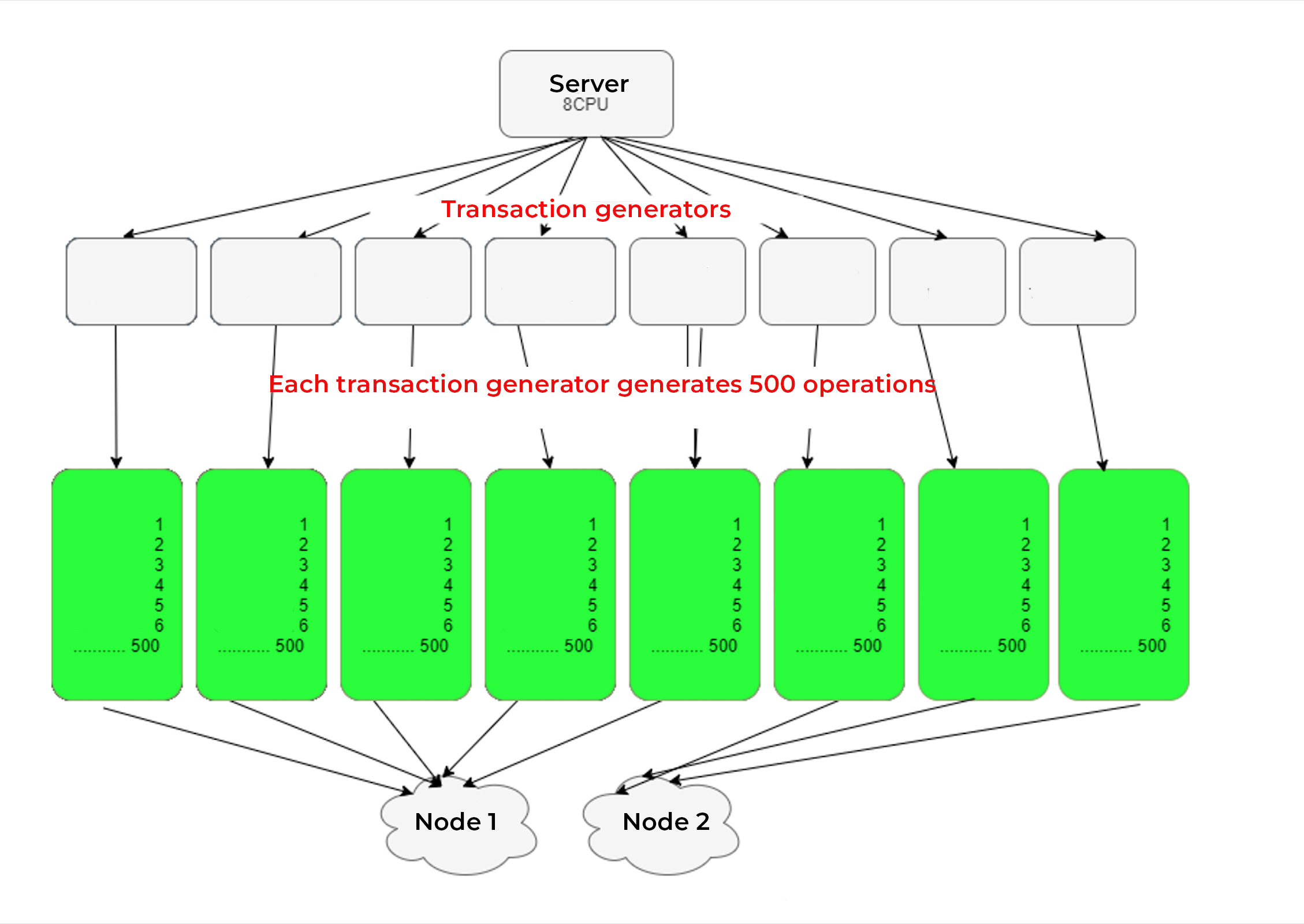
The transaction generation process is running on each logical processor, each transaction contains 500 operations. Attention, a larger number of operations is possible, but a larger number increases the generation time of a single transaction.
When generating 500 operations, the execution time takes 1 second.
Attention: during testing, coins are sent to the warhead and you need to make sure that the coins are available on the robot’s accounts.
Each operation sends an amount from 0.00001 to 0.001 coins. The amount is generated randomly.
Commission for each operation: 0.005
Thus, in a second, the system will use up. Up to 70 GBL.
In this implementation, the number of operations in the blockchain reaches 8000 on servers in 2 GB RAM. But it indicates the number of transactions – that is, the number of servers that have written data to the block in parallel.
The screenshot shows that there are 4 transactions in this block. This means that 4 servers sent transactions and they got into the current block. In this example, there are 1000 operations in each block.
 The block is located at — https:/demo.gbledger.net/block/2012482
Stage 2. Mass sending of requests to blockchain to receive data
This technique is implemented in python.
The purpose of the task: The implementation of an algorithm for obtaining data on operations and stored data of the warhead.
To implement this task, 2 servers are used:
Each server has 8 logical processors.
On each server, a process is running, divided into 80 subprocesses to generate the load. The load is performed via the Websocket protocol, and each thread performs a complete procedure for connecting and disconnecting from the thread.
Testing algorithms used:
get_block — Getting a list of all operations from the block
get_transaction-Getting a list of all operations from a transaction
get_global_properties-Getting static parameters of the warhead
get_dynamic_global_properties-Getting dynamic parameters of the warhead
get_accounts-Getting user parameters and balances
Test results
Load testing by data entry operations (money transfer operations, bidding)
Stage 1. The goal of 2000 operations
To conduct load testing for 2000 operations per second, it was involved:
— 1 server with 8 vCPUs.
The environment is running in 4 threads. Each of the threads generates 500 operations per second and transmits it to the network.
The time for generating and signing a transaction is 1.5 seconds
Load testing was performed for 2000 operations to the public node France.
The RAM consumption was 100 MB.
Operation block:
— http://gbl.presale-deex.exchange/block/2116839
— http://gbl.presale-deex.exchange/block/2116867
Action: Generating a load on a Public node using the Websocket protocol
| Number of requests | 2000 |
| RAM usage | 700 MB |
| CPU utilization | 10% |
The load on the network servers processing operations.
| Number of requests | 2000 |
| RAM usage | 500 MB |
| CPU utilization | 5% |
The goal is 4000 operations
To conduct load testing for 2000 operations per second, it was involved:
— 1 server with 8 vCPUs.
The environment is running in 8 threads. Each of the threads generates 500 operations per second and transmits it to the network.
The time for generating and signing a transaction is 1.5 seconds
Load testing was performed for 2000 operations to the public node France.
Schedule of RAM resource consumption
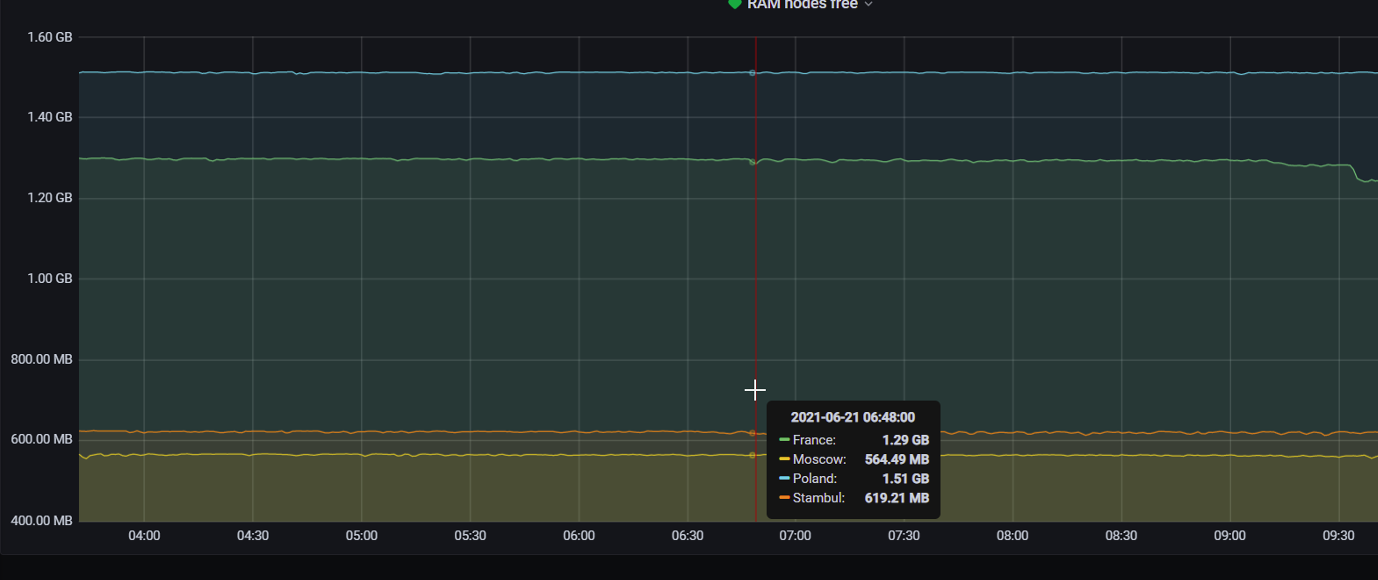
The RAM consumption was 400 MB.
Operation block:
— http://gbl.presale-deex.exchange/block/2117261
— http://gbl.presale-deex.exchange/block/2117271
— http://gbl.presale-deex.exchange/block/2117277
Action: Generating a load on a Public node using the Websocket protocol
| Number of requests | 4000 |
| RAM usage | 1100 MB |
| CPU utilization | 10% |
According to the results obtained during the load testing, the main load falls on the public infrastructure that accepts requests directly from the client (nodes).
Within the node itself, the most loaded resource when accepting a transaction is RAM, because when accepting transactions, data is pre-buffered with further distribution to Mempool. On the servers used in the testing process with 2GB of RAM, the peak load was 8000 operations per second.
| Number of operations | RAM resources |
| 1000 | 100 MB |
| 4000 | 400 MB |
| 8000 | 900 MB |
In addition to increasing the resources of the servers, you can go by using the available resources more economically. The resource intensity of public nodes is associated with the need to store up-to-date data in RAM to provide quick access to the consumer.
The node’s resource consumption can be reduced by increasing their throughput accordingly, by disabling part of the functionality that is not used in this mode of operation, i.e. by using the so-called Lite nodes.
This is a node identical in code to the full public one, the difference between them is only in the configuration. The parameters are responsible for configuring the resource intensity:
— the number of recent operations in the history that the node can display;
— the size of the node buffer. The higher the buffer, the higher the RAM requirements. The buffer is a balancer between receiving data from the HDD and RAM.
These results can say with a sufficient degree of confidence that when you add the required amount of RAM, you can get higher results in terms of network bandwidth. The theoretical network bandwidth embedded in the architecture of the solution reaches 100,000 transactions per second. To achieve such indicators and develop additional recommendations on hardware configurations, additional, longer testing is required using more powerful test servers with more RAM, faster SSD drives, faster network interfaces.
Читайте также:
>>> О КОМПАНИИ GENESIS BLOCK:
Компания Genesis Block – международный системный интегратор и разработчик финтех-решений, систем платежей и процессинга, систем биллинга и программных решений для ЖКХ, блокчейн-решений, веб-сайтов, порталов и мобильных приложений. Под брендом Genesis Block объединены компании, разработчики и сервисы, работающие на рынке с 2010 г. Качество наших сервисов подтверждается международной сертификацией по ISO. Входим в российскую ассоциацию программного обеспечения НП РУССОФТ. Genesis Block является постоянным главным спонсором и спикером на международных банковских и финансовых конференциях IFIN и ВБА (Вся Банковская Автоматизация). Аккредитованная IT-компания Минкомсвязи. Является членом РАКИБ (Российская Ассоциация Криптовалют и Блокчейна). С 2020 компания Genesis Block ведет собственную авторскую передачу на деловом телевидении ПРОБИЗНЕС. Являемся авторизованным официальным интегратором крупнейшей BPM / CRM системы Terrasoft.


