
Blockchain, mining and the environment: on the way to solving problems and achieving the Sustainable Development Goals

We are used to the fact that blockchain is presented as a tool that provides speed, efficiency and low transaction costs. But everything has a downside. Now, when, thanks to the development of DeFi and NFT, there is a real boom in the IT industry, and the technology of distributed registries is becoming more and more popular, the discussion of their negative impact on the environment is also intensifying.
The work of the blockchain requires the consumption of a huge amount of energy. And this number is growing every day. Is it possible to come to a solution that would bring the technology capable of changing the world to harmony with this world and compliance with the Sustainable Development Goals developed in 2015 by the UN General Assembly as a «plan for achieving a better and more sustainable future for all»? To understand this and make blockchain not an enemy, but a friend of the environment, we need to go back to the basics of how blockchain works and understand whether this technology has the potential to contribute to a positive impact on the climate?
How mining works
The two largest blockchain platforms — Bitcoin and Ethereum – still use the Proof–of-Work (PoW) mechanism in their work with a system for extracting new coins using mining. Miners are responsible for processing transactions and adding them to the blockchain. These users compete for computing power and try to solve very complex algorithmic problems with the help of specialized computers that perform trillions of operations per second. In exchange for such processing, the winner receives new cryptocurrencies. The essence of mining boils down to the fact that the most powerful computer exerts the greatest amount of effort in computing. Other computers on the network quickly check them and add a new block containing additional information to the blockchain. After that, the mining process begins again.
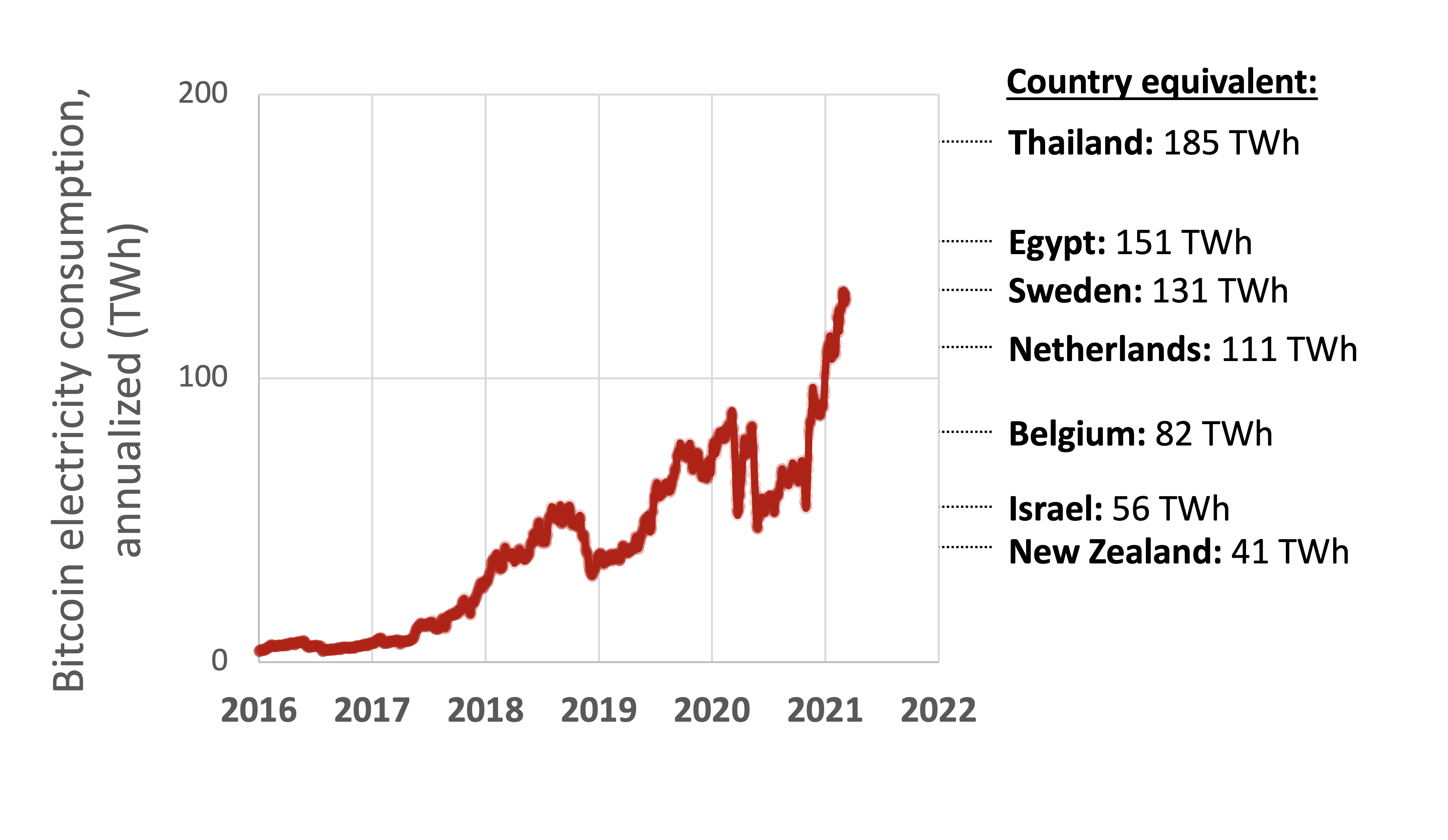
Is it worth explaining that the «most powerful computer» is also the biggest consumer of energy. Since the crypto miner increases the probability of determining the correct answer by increasing the number of «guesses», this process further increases computing power and increases energy costs. Today, PoW manners require a large number of so-called applied integrated circuits (ASICs) to have at least some chance of reliable earnings of cryptocurrencies. The profitability of mining, as well as the increase in the cost of PoW currencies, require more and more energy to power and cool machines.
Environmental impacts
Over the past few years, the environmental impact of mining has increased significantly both in terms of energy consumption and in terms of carbon or CO2 emissions.
According to the researchers, one bitcoin transaction consumes as much energy as the average American household would consume in 73.82 days (2.5 months). Since mid-2021, the annual energy consumption in the Bitcoin network has grown from 78 Terr (trillion) watt-hours (TWH) to almost 198 TWh last year. Ethereum, although less demanding on energy, still uses as much electricity for a single transaction as a household in the US in 8.32 days. The annual energy consumption of the Ethereum network has grown from almost 15 Twh to more than 92 Twh.
Bitcoin is also the most polluting cryptocurrency. In total figures and based on estimates made in 2021, the mining of this cryptocurrency led to the emission of more than 56.8 million tons of CO2 into the atmosphere (or more than 1,000 pounds of CO2 per transaction). To compensate for such a scale of pollution and make Bitcoin mining carbon-neutral, additional planting of more than 280 million trees will be required.
To compare the scale of pollution from mining, it is worth saying that as a result of mining in the same year 2021, just over 22 million tons of CO2 were emitted.
The likelihood that consumers and the industry as a whole will have too little energy left, some countries are banning or planning to ban crypto mining. In China, where 70% of the world’s miners were based, such measures have already been taken. Taking into account that most of the crypto mining has been moved to countries with lower energy prices, the current high electricity prices caused by the crisis in Ukraine have forced countries such as Kosovo and Kazakhstan, as well as Iran and India to also ban crypto mining. In the EU, an official of the ESMA (European Securities and Markets Authority) is ready to join the ban on mining in the near future.
While it seems obvious and effective to solve the problem of CO2 emissions and high energy consumption by banning cryptocurrency mining, such a decision can seriously slow down the development of the blockchain. And therefore, it is possible and necessary to look for solutions that can return the blockchain to the status of «green» technology. The most promising is the transition from Proof-of-Work (PoW) to Proof-of-Stake (PoS). The operability of PoS-blockchains is supported by validators — owners of cryptocurrencies. They verify user transactions, and if at least 2/3 of the validators agree that the transaction is correct, it is included in the new block of the blockchain. Validators are engaged only in useful work (verification), and not in sorting numbers, so they do not have a race for performance, like miners.
The GBLedger blockchain developed by Genesis Block uses exactly such a consensus algorithm in its work. And in addition to high environmental friendliness, it has a number of additional preferences.
According to a UCL (University College London) study, proof-of-stake networks consume much less energy – from two to three orders of magnitude less than Bitcoin. The same study says that PoS systems can contribute to solving problems related to climate change, and can even reduce the energy needs of traditional central payment systems, which gives hope that blockchain technology can still make a positive contribution to the fight against climate change.
PoS-based blockchains can also be used in projects of so-called green smart contracts. Green smart contracts open up new ways to combat climate change and overcome the negative consequences of its change. And this is already consistent especially in areas requiring the collection and verification of large amounts of data and the promotion of sustainable environmental behavior, such as regenerative agriculture, carbon offsetting, crop insurance, etc. Green smart contracts can make great promises in solving environmental problems, as they expand the scope of environmentally oriented blockchain-based solutions. And this is an excellent application for compliance with at least 7 and 12 Sustainable Development Goals declaring «Access to inexpensive, reliable, sustainable and modern energy» and «Ensuring rational consumption and production models».
Blockchain Counts Carbon
It is not for nothing that we mentioned green smart contracts and cited them as an example of a reasonable and responsible use of blockchain to conserve natural resources and reduce CO2 emissions. After all, smart contracts on the blockchain are an ideal platform for the implementation of the carbon registry creation program.
The basis of this system is the so-called «carbon points», the use of which allows for greater liquidity, transparency, accessibility and standardization of carbon markets. Built on the blockchain, such a system can unite all stakeholders (wind farm projects, tree planting, CO2 absorption, etc.), create a tokenization mechanism with clear protocols for the release and burning of «greenhouse units», their transparent distribution and trade.
Consumers of carbon points are companies that emit carbon or pollutants of any kind in their production. Validators are accredited, technically competent companies that monitor harmful industries and have the ability to write off carbon points.
Buyers and sellers of carbon credits can use a decentralized exchange platform on the blockchain to trade carbon credits. The price will be determined by the market dynamics determined by supply and demand. Such tokens will be «burned» by sending these tokens to a smart contract or a specific blockchain address, the private key of which is unknown to any party and can be seen by a team of validators, as well as regulatory authorities.
Companies and individuals who successfully burn their carbon tokens will be issued irremovable tokens as a certificate for carbon removal.
The scheme of interaction of all parties is shown below.
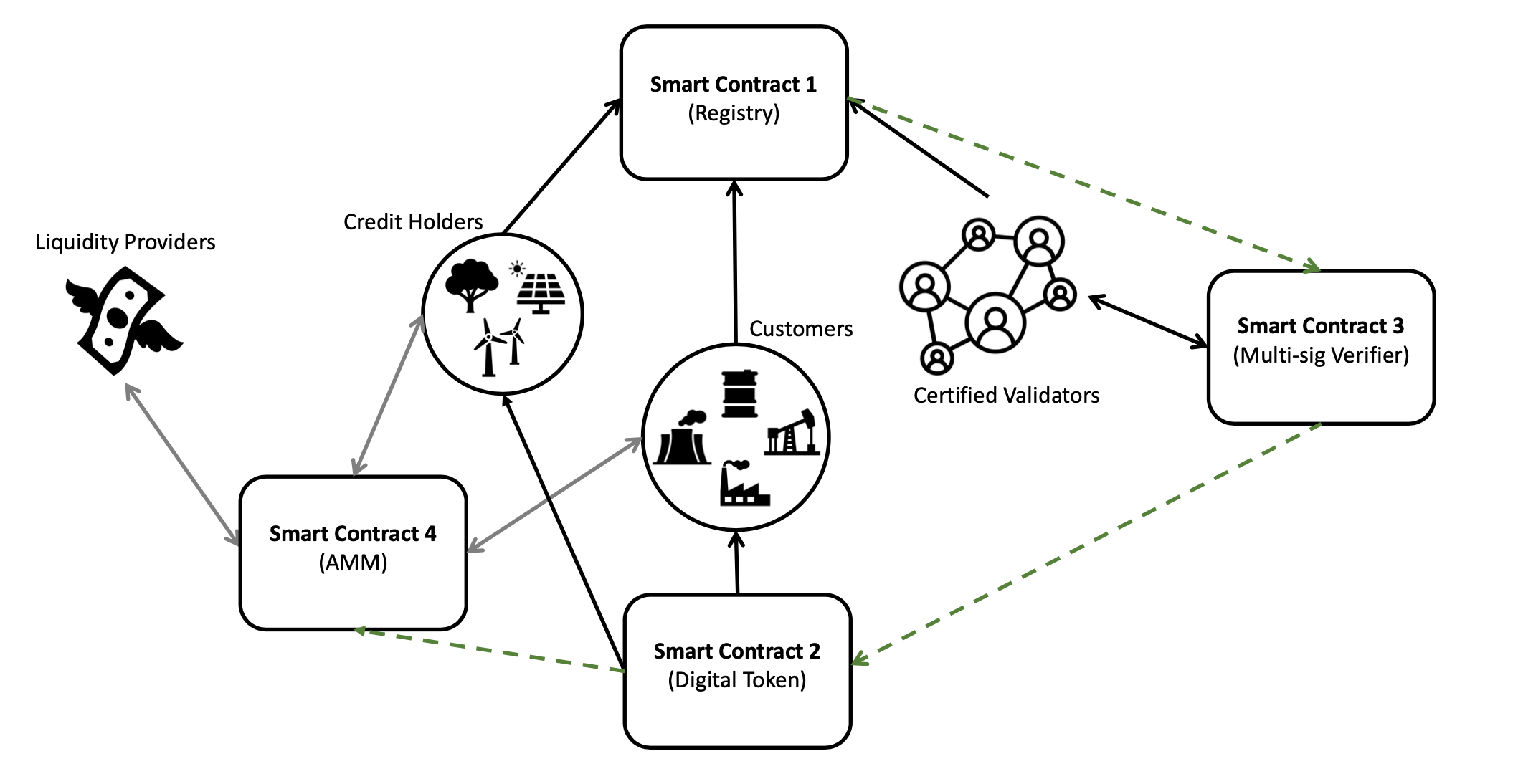
Verifiers (Validators): confirm the presence of carbon points from their holders. They also verify that burning carbon tokens is equivalent to burning a proportional number of emissions.
Credit holders: Organizations that already have carbon points in the emissions trading ecosystem.
Buyers (Customers): individuals and companies interested in offsetting their carbon footprint by buying carbon credits and burning a carbon token.
Smart contracts of the system have the following functionality:
— Approval of the number of points issued;
— Issue of carbon tokens;
— Make the carbon token transferable and suitable for burning,
— Burn offsetting carbon tokens,
— Issue interchangeable tokens as a sign of the successful burning of carbon tokens representing carbon offsetting emissions
A multi-signature smart contract allows verifiers to verify the release and burning of carbon tokens. The automatic execution of this contract will require the approval of at least 70% of the inspectors.
The smart contract (4) of the Automated market maker (AMM) allows:
— Conduct automated token trading for digital currencies (for example, stable coins or digital currencies of the central bank),
— Encourage liquidity providers by charging a transaction fee.
— Provide dynamic determination of the token price in the free market.
The green blockchain
Despite the rather gloomy picture drawn by eco-activists when analyzing the cryptocurrency and blockchain market, the situation may change. To do this, it is enough just to change the approach to the work of the blockchain and find common ground for the reasonable existence of the digital and real worlds. Genesis Block already clearly feels these points and is able to put the blockchain at the service of ecology.
Читайте также:
>>> О КОМПАНИИ GENESIS BLOCK:
Компания Genesis Block – международный системный интегратор и разработчик финтех-решений, систем платежей и процессинга, систем биллинга и программных решений для ЖКХ, блокчейн-решений, веб-сайтов, порталов и мобильных приложений. Под брендом Genesis Block объединены компании, разработчики и сервисы, работающие на рынке с 2010 г. Качество наших сервисов подтверждается международной сертификацией по ISO. Входим в российскую ассоциацию программного обеспечения НП РУССОФТ. Genesis Block является постоянным главным спонсором и спикером на международных банковских и финансовых конференциях IFIN и ВБА (Вся Банковская Автоматизация). Аккредитованная IT-компания Минкомсвязи. Является членом РАКИБ (Российская Ассоциация Криптовалют и Блокчейна). С 2020 компания Genesis Block ведет собственную авторскую передачу на деловом телевидении ПРОБИЗНЕС. Являемся авторизованным официальным интегратором крупнейшей BPM / CRM системы Terrasoft.


